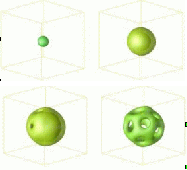
 Melts of one or more kinds of polymers exhibit a wealth of diverse phases whose geometric properties make them interesting systems not only for condensed matter research, but for industrial applications, as well. Specifically, block copolymers made of chemically incompatible monomers (say, A and B) exhibit microphase separation, thus forming regular nanoscale patterns of varying complexity. In solvent, they self-assemble to nanoparticles or vesicles which can be used, e.g., as nanocontainers. Melts of one or more kinds of polymers exhibit a wealth of diverse phases whose geometric properties make them interesting systems not only for condensed matter research, but for industrial applications, as well. Specifically, block copolymers made of chemically incompatible monomers (say, A and B) exhibit microphase separation, thus forming regular nanoscale patterns of varying complexity. In solvent, they self-assemble to nanoparticles or vesicles which can be used, e.g., as nanocontainers.
Among other, we study the influence of curvature on structure formation and pattern orientation in thin films and membranes, and we are interested in the effect of crosslinking for the stabilization of ordered structures. Furthermore, we use dynamic self-consistent field theory to study the kinetics of structure formation, e.g., in solutions containing amphiphilic block copolymers.
Another important application for polymers is to attach them to surfaces, thus modifying the surface properties. We are interested in the effect of polydispersity on the structure of such ''polymer brushes'', and on strategies to design smart surfaces that can be used as sensors and switches. For more information, please contact Friederike Schmid .
|
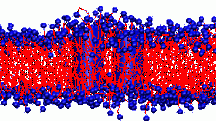 All living things depend on membranes. Their basic structure is provided by lipid bilayers, which self-assemble spontaneously in water due to the amphiphilic character of lipid molecules - they contain both hydrophilic and hydrophobic units. In our group, we are interested in generic properties of such amphiphilic bilayers.
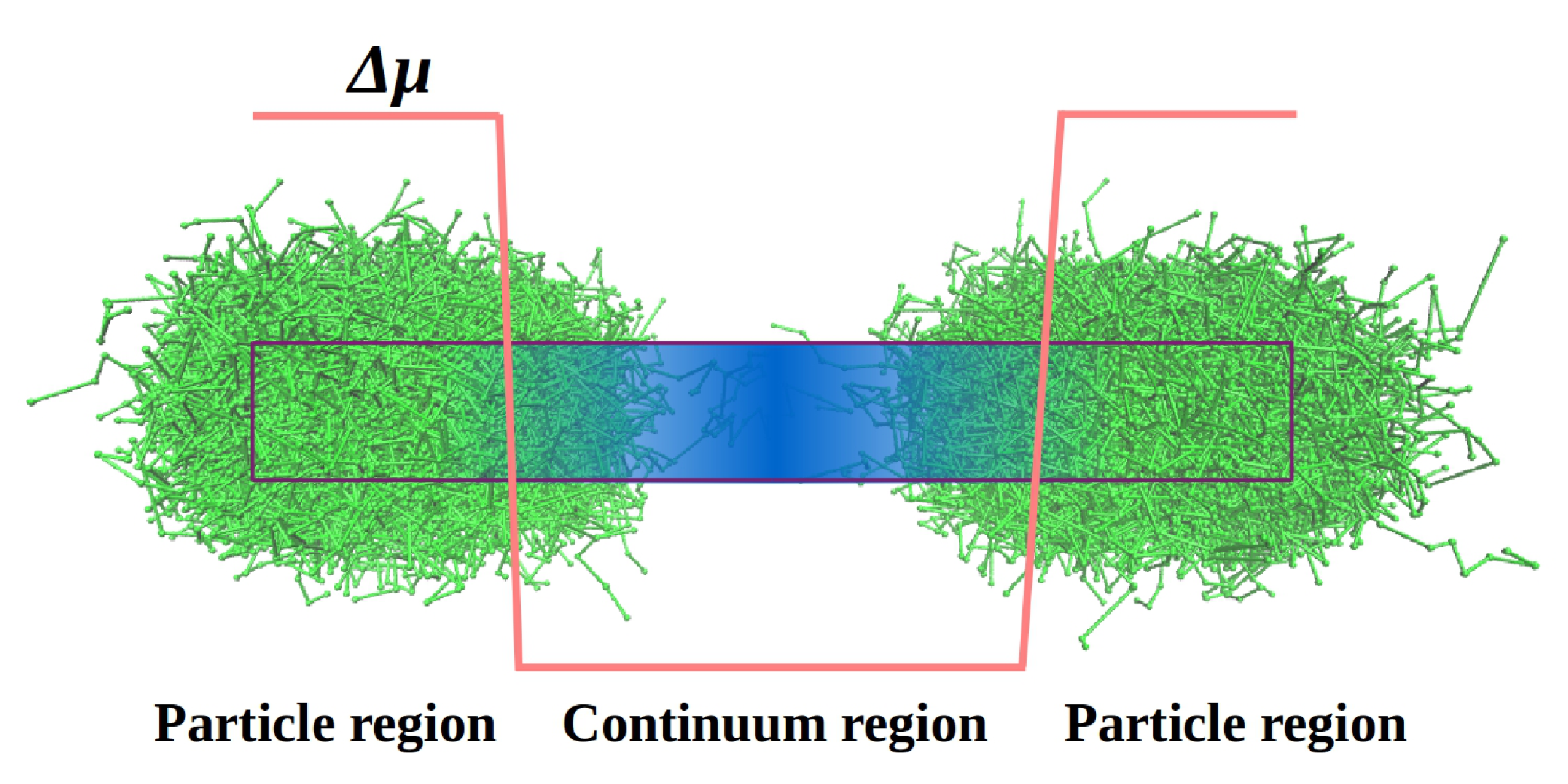 The so-called 'self-consistent field' (SCF) theory is one of the most successful density functional theories fo inhomogeneous polymer systems, which allows to calculate the local structure of dense blends at an almost quantitative level (see
 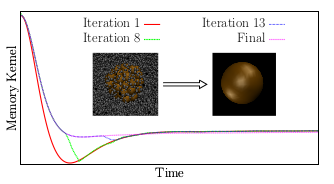 In soft matter, the separation of time scales is often incomplete and memory effects become important. We develop coarse-graining strategies for such situations, using the example of colloidal dispersions. We develop methods to reconstruct memory kernels in simple and complex fluids (e.g., electrolyte fluids). Our goal is to construct implicit solvent models that include memory effects and can be used for equilibrium and non-equilibrium simulations. In this context, we also develop algorithms for the efficient simulation of coupled generalized Langevin equations. For more information, please contact